Backyard Produce Not Harvested
An astute Save the Harvest reader has raised the question of backyard citrus (yes, we live in Southern California, but try substituting apples or peaches in case that works better for your neck of the woods) that falls on the ground and never gets harvested. How do we save that?
To this question I applied my finely honed research skills, practiced daily in my other life, to discover some options. As it turns out, all the options I found appear to be home grown. That is, there is no global solution to the management of backyard produce lost due to sheer abundance. My research uncovered at least two local solutions to the management of backyard abundance.
Hillside Produce Cooperative This organization began in North East Los Angeles, but it now has six geographically dispersed chapters and over 300 members. Here’s how founder Hyden Walch describes the North East Los Angeles Calfornia cooperative: “It’s a free neighborhood monthly exchange of all the FRUITS, VEGETABLES, HERBS and FLOWERS we grow in our yards, a collective in which we all get to enjoy some of what everyone grows in exchange for contributing what we don’t want or won’t use ourselves. Then no food is wasted and we all get a variety of fresh local produce to eat for free.” Hyden has set up a system of exchange that takes place once a month on a Saturday morning. The website includes good information on how to get organized in your area. Other chapters have formed in West LA, Ventura, Murietta CA, Merced CA, and as far away as Kingston Canada.
 Food Forward, another Los Angeles based organization works to pick, donate, and distribute food for humanitarian purposes. Here’s an excerpt from their Mission Statement – “Food Forward’s mission is to reconnect people with people – through food – by bringing together volunteers and neighbors to share in the gleaning and distributing of locally grown food from private homes and public spaces which is then used to help feed the hungry.” Can’t argue with that. For further inspiration, Food Forward provides links to other gleaning groups:
Backyard Bounty
Village Harvest
Portland Fruit Tree Project
SoCal Harvest
Harvest Westchester
Inland Orange Conservancy
I heard a story on the radio this morning about how hard it is for teens to find work these days. You can’t help but wonder if they might provide the seeds of a labor force to get something like this off the ground in your community. Any takers?
It’s OK to Eat Some of the Harvest
You don’t have to preserve everything! Eat some now, and it doesn’t get any easier than this tomato salad. In fact, the gardener made this salad all by himself.
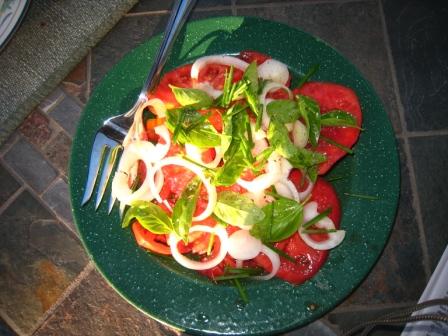
Easy Tomato Salad
Slice tomatoes onto a plate. Sprinkle with fresh basil or chives. Add sliced onions. We like sweet onions such as the Vidalia or Maui Maui, but green onions (scallions) or no onions will also work. Drizzle with olive oil and Balsamic vinegar. Chill and serve.
Pick Some Pablano Peppers
My gardener has started bringing peppers into the kitchen. Yesterday’s harvest included Pablanos. We used them to make chili rellenos. If you want the recipe, I’ll be happy to share. Just ask.
For now I want you to know that had the gardener opted to leave the peppers on the bush, they would have turned from a bright green to red. The red chilies are hotter and more flavorful than the green stage. Dried Pablano chilies are known as Ancho chilies.
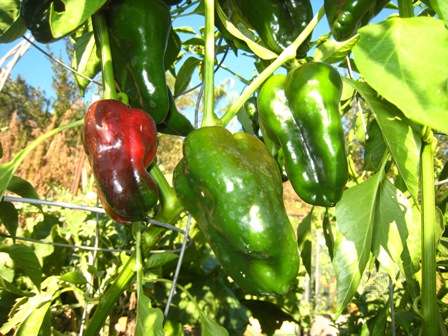
Pablanos in varying stages of redness
The powder from ground Anchos makes a great seasoning.
Summer Squash – Zucchini and Crook Neck
Summer squash comes in a variety of shapes, sizes, and colors.

Bad news. Summer squash doesn’t freeze very well. It tends to go all watery on you. There are some other preservation options, and we’ll get to those in due course. If you’re not interested in pickling, canning, drying, or leaving squash on your neighbor’s doorstep in the wee hours, get your gardener to stop planting so much summer squash. I’ve got mine limited to one zucchini and one crook neck plant. Period.
In the meantime, eat as much fresh squash as you can while the harvest is fresh. It doesn’t get any better than this.
Two ideas –
Crook Neck Squash
Slice the yellow squash into circles about 1/2 inch thick. Put these in a saucepan with an equal amount of sliced onions, a bit of salt and pepper (I like lots of pepper), and just enough water to cover the bottom of the pan. Simmer until the vegetables are soft but still hold their shape. Over cooking the squash will cause it to fall apart. Eat and enjoy.
Stewed Zucchini
Slice the zucchini into circles about 1/2 inch think. Put these in saucepan with an equal amount of quartered tomatoes (unpeeled is OK) and sliced onions. Salt and pepper to taste. Simmer until the vegetables are soft. Use a pair of tongs to lift out the tomato peels. Yum!
Easy Tomato Paste – Trust Me
Just when I thought it was safe to go back in the kitchen, another basket of tomatoes appears on the counter. No problem. I’ve seen this before, and I’m ready.
Here’s my approach to tackling those Romas and other “meaty” tomatoes.
Slice long ways.
Arrange cut side up on baking sheets.
Optional: sprinkle with herbs (basil, oregano, marjoram), sliced
onions, garlic
Not optional: drizzle with olive oil
Bake at 250 degrees for one to two hours – until the tomatoes are
“broken down” and no longer juicy. (That’s a precise cooking term.)
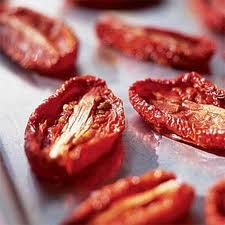
No longer juicy tomatoes look kind of like this.
Put the roasted tomatoes in a food processor and process until fairly
smooth.
Freeze in ice cube trays, and store frozen cubes in a container in the
freezer.
These will keep all winter and can be used in soups, stews,
sauces, casseroles, and as a quick pizza sauce.
Easy Freezing – Tomatoes
The tomato harvest has begun!
Right about now many gardeners are enjoying fresh tomatoes in their salads and sliced tomatoes on their sandwiches. We’re also looking at that basketful of redness on the kitchen counter and trying to figure out what to do next.
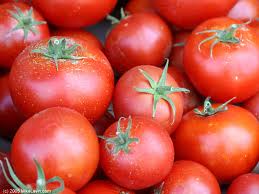 Our motto at Save the Harvest – waste not, want not. Here’s all you need do to save the abundance of tomatoes for future enjoyment.
Wash the whole tomatoes, place them in a freezer bag or container, and put them in the freezer. That’s all folks!
When the time comes to use these summer gems, just drop them into soup, stew, or a sauce. As they cook you can lift off the skins and pinch out the stem end with a pair of tongs.
Optional Preparation Steps: Remove the stem end with a paring knife before freezing. Dip them in boiling water for 30 seconds or so, then cool the whole tomatoes in ice water to slip off the skins. Now put them in that freezer container, and they’re ready to use in months to come.
Two Tips for Managing Frozen Tomatoes
Freeze tomatoes in serving size containers. One quart freezer bags work well, as this quantity goes well in most soups and stews. When it’s time to use them, you simply warm the bag a bit either by sitting it out at room temperature for 30 minutes or so, dipping it in water, or zapping it in the microwave for 30 seconds. With that the block of frozen tomatoes easily slides out of the bag to go into the soup.
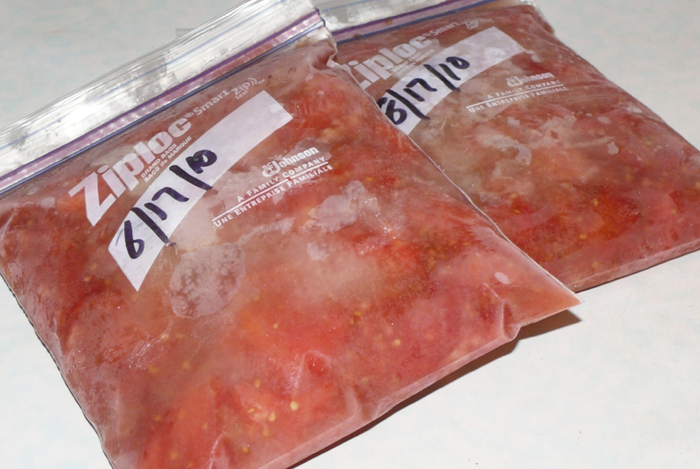
Good idea to note the freeze date
Freeze tomatoes on a cookie sheet. Once they are firm, transfer them into freezer bags or containers of any size. Now you have individual tomatoes you can use as needed.
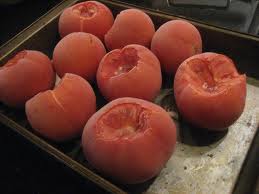
Use a pan that fits on a shelf in your freezer.


 Save the Harvest